This is a synopsis of The AI Doc: Or How I Became an Apocaloptimist:
A father-to-be tries to figure out what is happening with all this AI insanity. The AI Doc: Or How I Became an Apocaloptimist is a hand-made, eye-opening documentary about the most powerful technology humanity has ever created…and what’s at stake if we get it wrong.
The following review tells the whole story. With that spoiler alert, you may wish to leave this screen and watch The AI Doc, which you can easily do in the comfort of your home. Even if you stick around, be sure to see the movie. So, here we go:
Art reflected life as I stepped into the darkened theater.
I was in the heart of San Francisco, where all AI startups seem to be born.
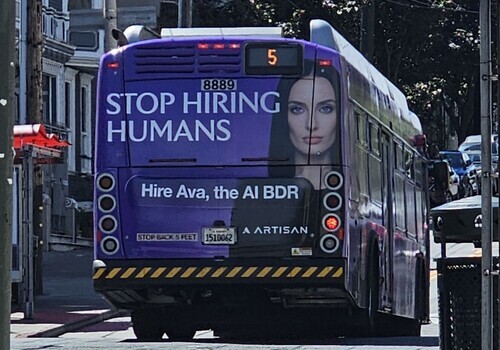
In the weeks I’d been visiting the city, I’d pass people on the street and wonder: did they have a hand in a phenomenon compared to the discovery of fire? Billboards shouted AI’s benefits. Ads on busses screamed: “STOP HIRING HUMANS.”
I sit next to my daughter-in-law—herself an executive at an established startup. My son is back at their apartment recovering from upper jaw surgery. His art studio is blocks from the theater. From early days, he’d sketch in the margins of his school papers and notebooks. Soon after graduating from college with a degree in industrial design, Nike had hired him in part for how he could draw up great ideas on the fly.
Co-director and on-screen narrator Daniel Roher draws or paints most of the graphics in the movie. Sketchbooks will play a central and active role.
As the movie begins, we see Daniel as a boy, learning about computers and having fun making his own videos. His relationship with technology seems sympatico until one day, he notices that computers have begun to churn out entire screenplays. His dander up, he determines to find out more about this precocious digital intruder.
The pounding beats of Neil Young’s dystopian “We R in Control” attend Daniel as he sets up to ask the experts: What is AI? They stammer to define it and confirm our cloying worries. “Super intelligence” will have more intelligence than all of humanity. The goal is to supplant all human labor. Our species could be exterminated.
Daniel asks tech truth-sayer Tristan Harris—whom The Durable Human has followed for a decade—if we are doomed. He pauses and says, “It’s not good news.”
Suddenly: a change of pace
The music turns hopeful—even giddy. Daniel and his wife Caroline Lindy are expecting a baby!
Eerie parallels with my life continue. My son is home with the sleeping infant he and his wife had 5 months ago. While in SF, I delighted in taking care of him, too.
Babies are central to me for other reasons. I have two other perfectly wonderful grandchildren.
I’m also co-founder of the Global Alliance for Inspiring Non-tech Infant Nurturing and Growth, or GAINING. A group of child development experts from 43 countries—all are apprehensive about AI’s effects on young children.
So, when Tristan says, “People who are [working] in AI Risk don’t expect their kids to make it to high school,” my eyes well up.
As Daniel (and I) plunge into the depths of despair, Caroline announces to her husband that she can’t live with his abject dejection—not while she is pregnant. “You’re gonna have to figure out a way to have hope.”
Thus, Daniel seeks out the Optimists
Nvidia CEO Jen-Hsun Huang is but one who describes a no-illness, no-poverty, no-scarcity world. AI will free us from labor and routines so we can follow our hearts’ desires. Ultrasmart, always-on tutors will teach any student every subject. Our minds will meld with technology and we’ll be better for it.
About the time I launched The Durable Human in 2009, my writing buddy told me about Ray Kurzweil’s The Singularity is Near, which embraces that melded future. The book still sits on my shelf, but I never could bring myself to read it all the way through.
Peter Diamandis is the executive chairman of Singularity University. He proudly tells Daniel we can expect our brains to connect to the cloud within a decade—”by the early- to mid-2030s.”
As that thought resonates, our focus shifts again
Gentle strains of “Harvest Moon” play as Daniel and Carolyn observe a sonogram of their baby boy. “Ooh, he likes Neil!” Daniel exclaims as the baby moves along with Young’s second song in the movie.
Later, their thoughts float to AI and Daniel tells Caroline he wants to side with the optimists. That may be so, she reflects, but we still must be very careful —like with doing brain surgery. Done right, it can save the patient. “But it’s still incredibly dangerous and scary and you have to take every precaution possible in order to make sure it all goes well.”
Daniel then calls on Aza Raskin to make sense of things. Aza is the inventor of infinite scroll, the digital design technique notorious for keeping untold billions compulsively using screens. Now Aza runs—along with Tristan—the Center for Humane Technology, with the goal of nudging tech design in a more human-supportive direction.
To avoid a disastrous AI future, Aza says, we must “find the middle ground.” Tristan agrees that “the bad and good are inexorably linked.” We need to contend with both.
We are reminded how hard that will be as we see despondent parents, who lost their children to suicide after they engaged with AI chatbots, plead with Congress for guardrails.
We are jarred by outputs of Open AI’s Sora—a tool that makes deepfake videos. Michael Jackson moonwalks through McDonald’s. Martin Luther King, Jr. says he actually doesn’t have a dream. Deepfake audio upends a real-life Slovakian election.
Modern philosopher Yuval Noah Harari warns: “Democracy is based on trust. If you lose all trust, democracy is impossible.”
The problem is not Chat GPT
As Tristan points out, our true worry should be Artificial General Intelligence—the ultrasmart phenomenon that will think and act on its own: “The real existential threat is pursuing the race to deploy the most powerful, inscrutable, uncontrollable technology under the worst incentives possible.”
As daunting as that sounds, Empire of AI author Karen Hao points out that if we throw up our hands and accept the status quo—or frame AI as “godlike”—we let companies off the hook and they have an excuse not to feel responsible.
At this point Daniel, in the form of a tiny action figure, beholds “Anxiety Mountain”—an artist’s rendering of his teeming pile of deepest fears. Daniel decides he will climb to the top and confront “the Oppenheimers of the moment”—the AI company CEOs.
Musk and Zuckerberg won’t take part, but Daniel manages to wrangle Open AI’s Sam Altman, Anthropic’s Dario Amodei, and Google DeepMind’s Demis Hassabis.
Soon after Sam Altman sits down, he mentions he will soon become a father. Graciously accepting Daniel’s mazel tov, Altman assures him “I am not scared for kids to grow up with a world with AI.” But adds, “Our kids will never be smarter than AI”
Altman claims his company is prepared if a product goes rogue. But when Daniel asks if he can promise things will go well (for humanity, we presume), Altman responds, “That is impossible.”
Demis Hassabis says we cannot “just stop” the AI train. Too many players around the world are active in the space.
Dario Amodei muses that, even if the U.S. does pass laws, to make a real difference, “we need to partner with other countries,” adding, “It’s up to all of us to get the government involved.”
After the interviews, lightning from a pulsating black cube that’s been hovering over Anxiety Mountain zaps the Daniel action figure to the ground.
In real life, his anxiety has only grown. He confides to his father, “I’m really scared, especially in the context of the baby.”
But, there’s no time for dread
The Baby is Coming!
Daniel sketches scenes of the successful delivery. We see the healthy baby. Daniel, Caroline, and their families rejoice.
Not long after, Daniel declares that he knows how the movie will end: “BABIES!” Everybody loves babies. They’re so cute and promising.
He will conclude that AI is way too complex and that “the future is not for any of us to decide.” But he’ll be the best dad ever to his son and “no matter what, we’ll be facing it together!”
Cut to wife Caroline looking incredulous.
“You’re going to end it with some kumbaya bullshit?”, she asks disbelievingly. We’re headed straight for disaster and “we hold hands and hope it works out? Absolutely not!”
And thus, we are called to Action
“WE GET TO DECIDE HOW THIS GOES!” Caroline defiantly declares. If we pool our human resources and act together, we can yank the AI wheel in the right direction.
“Let them know you are not happy with the current status quo,” urges Tristan. Pressure them we want something else to happen. Demand greater transparency, independent evaluation, safety standards, legal liability, and ground rules.
We’re in a new place now, Caroline continues. “We can’t be an optimist or a pessimist. We need to be something else.”
RAND’s Jason Matheny says his friend calls him “an apocaloptimist.” Daniel instantly adopts it as his new favorite word.
Finally: the durable human message
UCLA professor Ramesh Srinivan states it beautifully:
“I don’t believe in doom. I believe in the spirit of Life. And I believe that Life is about the capacity to act, the capacity to relate, the capacity to feel. We need to double down on the capacities that we have as humans that robotic systems will never have.”
Amen. We need to cherish and utilize what we as humans possess that machines don’t.
I wrote this back in 2013 in The Durable Human Manifesto, but intrinsically we all know it:
Each of us is one-of-a-kind and packed with extraordinary resources. Our senses go far beyond the Big Five. We have curiosity, conscience, compassion, integrity and intuition, to name just a few. We bestow and benefit from the magic of our warm touch and affirming glance.
And we can be wise.
“We are so much more than our intelligence,” Harrari reminds us. “Intelligence is the ability to solve problems. Wisdom is the ability to know which problems to solve.”
As I said in The Manifesto, “My hope is that if society begins to value what it means to be durable, human-only skills will be designed in to jobs rather than designed out.”
By this time in the movie, even black-hatted doomsayer Eliezer Yudkowsky of the Machine Intelligence Research Institute lightens up. “Don’t give up. Humanity has done more difficult things in its history. It’s just hard to convince people that they should.”
Scenes flash by of the film’s experts speaking and testifying, of the Berlin Wall falling, and of the crew of the International Space Station rejoicing as Daniel muses: “Big things seem impossible before they actually happen. But when they finally do happen it’s because millions of people took millions of actions to make them happen.”
We watch him walk out of his office carrying his little boy, as he concludes:
“And so, we have to try. There’s too much at stake.”
Words flash on the screen:
Credits roll to the searing “Lost it to Trying” by Son Lux. The second-last credit reads: THIS WORK MAY NOT BE USED TO TRAIN AI.
The very next day, our family cheered as our 5-month-old summoned the strength to flip himself over for the first time. His face beamed with joyful astonishment, as did ours. In that precious moment I, too, was an apocaloptimist. I would act to protect and preserve our humanity in the face of AI.
Within days, I was called to do just that.
About the author: Jenifer Joy Madden is a health journalist and child advocate who founded The Durable Human in 2009 and co-founded GAINING, The Global Alliance for Inspiring Non-tech Infant Nurturing and Growth in 2023. She has three grownup durable children, each of whom has a little one in training.
Read Jenifer’s books: The Durable Human Manifesto: Practical Wisdom for Living and Parenting in the Digital World and How to Be a Durable Human: Revive and Thrive in the Digital Age Through the Power of Self-design and watch her TEDx.
AI did not assist in the writing of this work.

Re: “artificial intelligence”
Well, everyone SHOULD of course get what AI is REALLY all about but most people CHOOSE not to want to understand it…
“Ignorance is the root cause of all Evil. Since only Knowledge eradicates ignorance, it is our duty and moral obligation to educate ourselves, as well as the masses around us.” — Anonymous
Like with every criminal inhumane self-concerned agenda of theirs the psychopaths-in-control sell and propagandize AI to the “awake” public with total lies such as AI being the benign means to connect, unit, transform, benefit, and save humanity.
The 2 major OFFICIAL deceptive fake FEAR-MONGERING narratives or phony pretexts (ie, lies, propaganda) nearly everyone, including “alternative news” sources, have been spreading is (1) that the TRULY big threat is that AI just creates utter chaos in society and that it might achieve control over humans (therefore it must be regulated, ie monopolized by the typical criminal governments); and (2) that we, the US, have to invest heavily in AI technological development so as to stay ahead of other nations, such as China (https://archive.is/pBzAt).
The TRUE narrative (ie empirical reality) virtually no one talks about or spreads is that the TRULY big threat with AI is that AI allows the governing psychopaths-in-power to materialize their ultimate wet dream to control and enslave everyone and everything on the whole planet, a process that’s long been ongoing in front of everyone’s “awake” nose …. https://www.rolf-hefti.com/covid-19-coronavirus.html
The proof is in the pudding… ask yourself, “how is the hacking of the planet going so far? Has it increased or crushed personal freedom?”
“AI responds according to the “rules” created by the programmers who are in turn owned by the people who pay their salaries. This is precisely why Globalists want an AI controlled society- rules for serfs, exceptions for the aristocracy.” —Unknown
“Almost all AI systems today learn when and what their human designers or users want.” —Ali Minai, Ph.D., American Professor of Computer Science, 2023
“Who masters those technologies [=artificial intelligence (AI), chatbots, and digital identities] —in some way— will be the master of the world.” — Klaus Schwab, at the World Government Summit in Dubai, 2023
“Around 2014-2015 the US National Security Agency (NSA) deployed an AI system called Skynet that placed people on a ‘suspected terrorists’ list, based on the electronic patterns of their communication, writings, travel and social media postings […] a former director of both the CIA and the NSA proclaimed that ‘we kill people based on metadata’” (Unknown)
“[…] what we are being sold through all this AI hype is that everything should be reducible to categories and hierarchies, put in the form of measures and statistics for prediction. However, if you understand that counting, measuring and predicting are always situated, and therefore subjective and political, you might not be as excited about such AI-determined futures. […]. The bigger AI project asks that you abandon meaning and feeling, to believe in a neutral, objective, all-knowing source built from massively large datasets hosted in hyperscale data centres. AI asks that you buy into the idea that more data means being closer to The Truth. It means that you should want to offload your limited cognition to the super machine. And perhaps most dangerously — that you understand all of this as a scientific endeavour.” — Mél Hogan, Associate Professor in Film & Media, 2026
“COVID is critical because this is what convinces people to accept, to legitimize, total biometric surveillance.” — Yuval Noah Harari, member of the dictatorial ruling mafia of psychopaths, World Economic Forum [https://archive.md/vrZGf]
“The whole idea that humans have this soul, or spirit, or free will … that’s over.” — Yuval Noah Harari, member of the dictatorial ruling mafia of psychopaths, World Economic Forum [hhttps://archive.md/vrZGf
“It looks to me like AI has been tasked with creating literally millions of fake videos tailored for every possible interest, to snare you in an endless loop, waste as much of your time as possible, stir your brain, create fear and unease, and make it impossible for you to tell reality from fiction. Why? TO KEEP YOU FROM STARTING THE REVOLUTION.” — Miles Mathis, American author, 2026
How can the masses get out of this mess? Everyone needs to first learn what true morality is (it’s NOT the same as religious morality): https://www.whatonearthishappening.com/news/988-mark-passio-interviewed-by-axel-dahi-2026-04-16.